
Walk into the finance office of most Kenyan boarding or day schools and you'll find some version of the same setup: an exercise book or Excel sheet with a column per student, a stack of triplicate receipt books, and someone — usually the bursar or a teacher who drew the short straw — reconciling M-Pesa SMS messages against paper records by hand at the end of each day. It works, in the sense that fees do eventually get collected. It also means nobody can answer "which students in Grade 5 still owe transport fees" without an afternoon of manual counting, and every term-end is a scramble to figure out who actually paid what.
The problem isn't that schools don't use M-Pesa
They do — overwhelmingly. M-Pesa is how school fees move in Kenya, whether it's a parent sending money directly to a teacher's personal line, a Paybill number scrawled on a fee structure printout, or a walk-in cash payment that gets deposited later. The problem is that M-Pesa on its own is just a payment rail, not a record-keeping system. It tells you money moved; it doesn't tell you which student it was for, which term, which fee type (tuition vs. transport vs. activity fees), or what balance remains. That reconciliation work still happens manually, and manual reconciliation is where errors, disputes, and lost receipts live.
This gets worse, not better, as a school grows. A 200-student primary school can just about survive on spreadsheets. A 600-student boarding school running CBC, with transport routes, multiple guardians per student, and staff turnover in the finance office, cannot — not without someone eventually losing track of a balance, double-charging a parent, or spending a full day producing a balance report a proprietor asked for an hour ago.
What Emore School System actually does
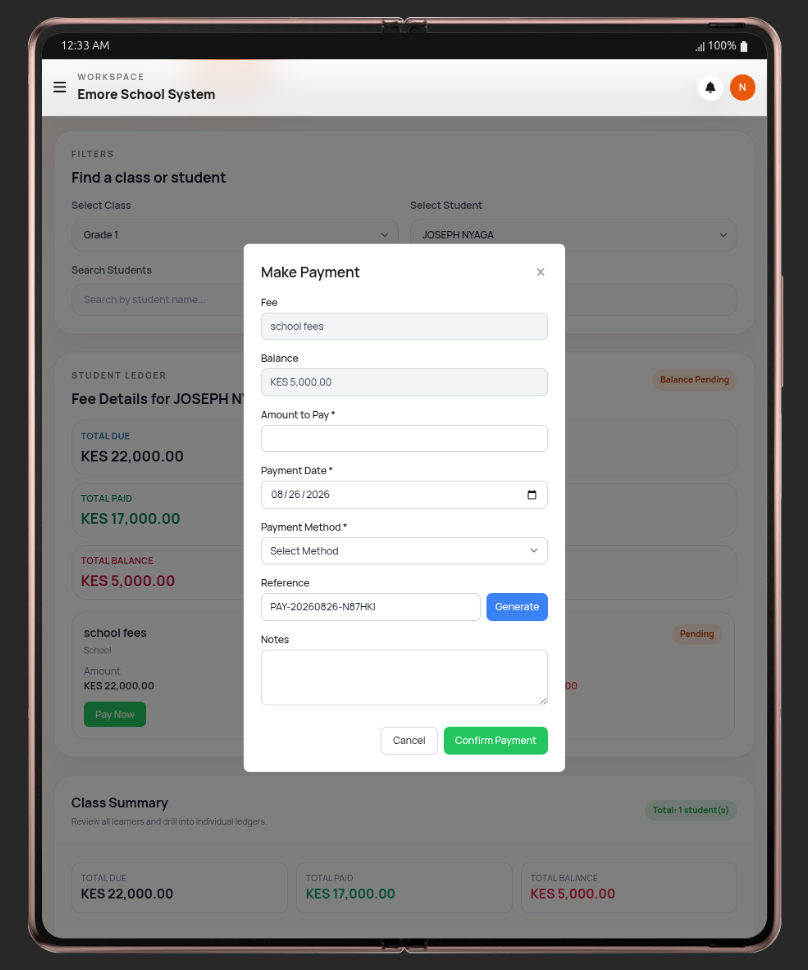
Emore School System is a fee management platform built specifically around how Kenyan schools actually collect money, not a generic accounting tool with M-Pesa bolted on as an afterthought. The core of it is simple: every student has a live balance, broken down by fee type, updated the moment a payment lands — whether that payment came in via M-Pesa STK Push initiated from inside the system, or was recorded manually because it came in as cash or a bank transfer.
From the Collection Desk, a bursar picks a class, picks a student (or searches by name or admission number), sees exactly what's owed across tuition, transport, and any other fee categories the school has set up, and can either send an M-Pesa prompt straight to a parent's phone or log a payment that already happened. No spreadsheet formulas to maintain, no manual subtraction to get a running balance — the system does that arithmetic every time, so it's never wrong because someone forgot to update a cell.
Reports that answer the actual question being asked
"How much do we still expect to collect this term" and "which students are high-risk for non-payment" are the two questions every school proprietor and finance officer asks constantly, and they're exactly the two questions a plain M-Pesa statement cannot answer. Emore School System's reporting is built around class-level balance summaries, high-risk account flags (students significantly behind on payment), and transport-linked obligations, exportable as PDF, Excel, or CSV whenever they're needed — not just at term-end, but on demand, in the middle of a Tuesday when a proprietor wants a number right now.
Every export carries the school's own branding — logo, name, contact details — pulled from what was entered during setup, so a report handed to a school board or a parent looks like it came from the school, not from a piece of software.
Every school's M-Pesa, not a shared one
A detail that matters more than it sounds like it should: each school connects its own Daraja Till or PayBill credentials. Fee payments go directly into the school's own M-Pesa account, on the school's own number, exactly as if the bursar had shared a Paybill number by SMS. Emore Systems never sits in the middle of that money. This is a deliberate design choice, not an accident — a school's fees are the school's fees, and a fee collection tool's job is to make tracking them easier, not to become a payment intermediary the school has to trust with cashflow.
Setting this up takes a few minutes from Settings, and until it's done, the M-Pesa prompt option simply doesn't appear — the system falls back cleanly to manual payment recording so a school can start using it for tracking and reporting on day one, and turn on M-Pesa collection whenever they're ready.
Built for how a school's team actually works
Not everyone in a school's finance operation should be able to do everything. An accountant needs to record payments and pull reports; a teacher might only need to see a class list; only the owner should be able to add staff accounts, see who else has access, or change another user's permissions. Emore School System enforces that by role from day one — Owner, Admin, Accountant, and Teacher each see and can do only what fits their job, which matters as much for basic operational sanity as it does for keeping sensitive financial access limited to the people who actually need it.
Guardians, transport, promotions — the parts that make fee tracking messy in real life
Fee collection software that only handles the simple case — one student, one guardian, one flat fee — doesn't survive contact with an actual school. Emore School System tracks guardians separately from students (because siblings share a parent, and a parent's contact details shouldn't have to be re-entered for every child), tracks transport as its own fee stream tied to a specific route, and carries balances forward correctly when a class gets promoted at the end of a year. None of this is exotic; it's just the ordinary shape of how Kenyan schools actually run, and it's what a spreadsheet quietly gets wrong the longer it's used.
Getting started
New schools get a 7-day free trial with no card required — enough time to run the setup wizard (school details, classes, fee structure, staff accounts), import or add students, and try collecting a real payment before deciding whether to subscribe. After that, it's a flat monthly subscription, billed the same way everything else in the system runs: by M-Pesa.
If your school — or a school you work with — is still reconciling M-Pesa SMS messages against an exercise book at the end of every day, that's precisely the problem this was built to remove.
Tagged under
Related Articles

VAT in Kenya for SMEs: Practical Rules You Can Apply This Week
Understand VAT registration, filing cadence, and common mistakes that create penalties for...

PAYE Payroll Checklist: A Monthly Workflow for Zero Filing Stress
A clean process for PAYE calculations, employee records, and deadline control.

NSSF Remittance Best Practices for Growing Kenyan Businesses
Build a repeatable NSSF process that reduces errors and avoids costly compliance gaps.