
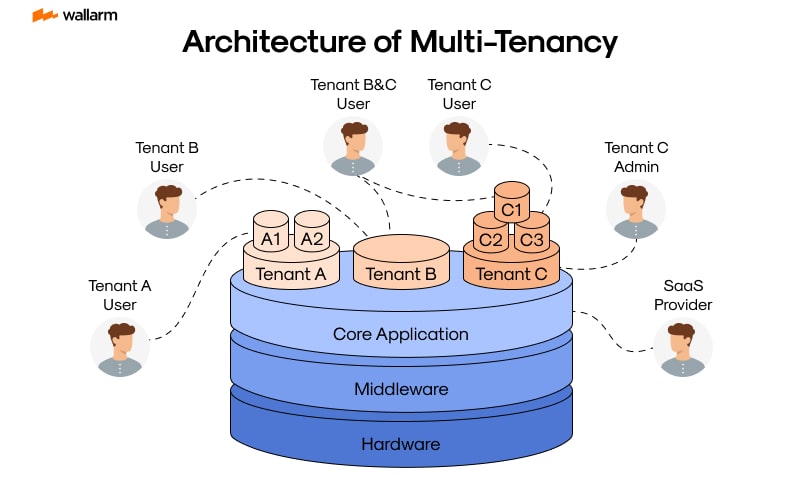
If you're building software that will serve more than one client, business, or organisation from a single codebase, you'll eventually run into the same question: how do you keep every customer's data separate, secure, and fast to query, without running a completely separate application for each one? This is the problem multi-tenancy solves, and Laravel — thanks to its clean architecture, service container, and mature package ecosystem — is one of the most practical frameworks for building it correctly.
This guide walks through what multi-tenancy actually means, the three main architectural patterns you can choose from, and how to implement each of them in a real Laravel application, including code you can adapt directly.
What Is a Multi-Tenant System?
A multi-tenant system is a single application instance that serves multiple independent customers — called tenants — while keeping each tenant's data logically or physically isolated from the others. Think of a SaaS invoicing platform used by hundreds of small businesses: they all run on the same Laravel codebase and the same servers, but Business A can never see Business B's invoices, customers, or settings.
The alternative — spinning up a completely separate deployment per customer — works, but it doesn't scale operationally. Every bug fix, feature, and security patch has to be deployed N times instead of once. Multi-tenancy trades a bit of upfront architectural complexity for dramatically lower long-term operational overhead.
The Three Core Multi-Tenancy Models
Every multi-tenant architecture is a variation of one of these three approaches. Which one you pick affects your migrations, your query patterns, your backup strategy, and how easily you can scale individual tenants later.
1. Shared Database, Shared Schema
All tenants live in the same tables, distinguished by a tenant_id column. This is the simplest model to build and the cheapest to run, because you have one database to migrate, back up, and monitor.
2. Shared Database, Separate Schemas
Still one physical database server, but each tenant gets its own schema (in PostgreSQL) or its own database (in MySQL, where "schema" and "database" are effectively the same thing). Tables are structurally identical across tenants but physically separate.
3. Database-per-Tenant
Each tenant gets an entirely separate database, sometimes on entirely separate database servers. This gives the strongest isolation and makes it trivial to move a large enterprise tenant onto its own dedicated infrastructure later.
Building Multi-Tenancy in Laravel: Two Practical Routes
Route A — Use a Dedicated Package
For most teams, the fastest and safest path is stancl/tenancy, the most widely adopted multi-tenancy package in the Laravel ecosystem. It supports both the single-database and database-per-tenant models, handles subdomain and custom-domain identification out of the box, and swaps database connections automatically per request.
A minimal setup looks like this:
composer require stancl/tenancy
php artisan tenancy:install
php artisan migrate

// Creating a tenant
$tenant = App\Models\Tenant::create([
    'id' => 'acme-corp',
]);
$tenant->domains()->create([
    'domain' => 'acme-corp.yourapp.com',
]);
Once installed, the package's middleware detects the incoming domain, resolves the matching tenant, and switches the database connection before your controller even runs — your application code barely needs to know tenancy exists.
Route B — Roll Your Own with a Global Scope
If you're on the shared-database model and don't need the full weight of a package, you can implement clean, safe tenant isolation with a global scope and a small piece of middleware. This is the approach I'd recommend for smaller SaaS products where a package feels like overkill.
Step 1 — Add a tenant_id column to every tenant-scoped table:
Schema::table('invoices', function (Blueprint $table) {
    $table->foreignId('tenant_id')->constrained()->cascadeOnDelete();
    $table->index('tenant_id');
});
Step 2 — Create a global scope that applies automatically:
class TenantScope implements Scope
{
    public function apply(Builder $builder, Model $model)
    {
        if ($tenantId = app('currentTenantId')) {
            $builder->where('tenant_id', $tenantId);
        }
    }
}

// In the model's boot() method:
protected static function booted()
{
    static::addGlobalScope(new TenantScope);

    static::creating(function ($model) {
        $model->tenant_id = app('currentTenantId');
    });
}
Step 3 — Resolve the tenant in middleware, early in the request lifecycle:
class IdentifyTenant
{
    public function handle($request, Closure $next)
    {
        $subdomain = explode('.', $request->getHost())[0];
        $tenant = Tenant::where('subdomain', $subdomain)->firstOrFail();

        app()->instance('currentTenantId', $tenant->id);

        return $next($request);
    }
}
With this in place, every Eloquent query against a tenant-scoped model is automatically filtered — controllers, API resources, and relationships all stay clean, with no repeated where() calls scattered through your codebase.
Pitfalls That Catch Teams Off Guard
Which Approach Should You Choose?
As a rule of thumb: start with shared database, shared schema, and a well-tested global scope. It's the cheapest to build and operate, and it will comfortably handle the vast majority of SaaS products up to a meaningful scale. Move to database-per-tenant only when you have a concrete reason — a large enterprise customer demanding data isolation, a compliance requirement, or a tenant whose usage pattern is genuinely disruptive to your shared database's performance.
Laravel doesn't force any one of these models on you, which is exactly what makes it a strong choice for multi-tenant products — you can start simple and graduate to a more isolated architecture later, without rewriting your application from scratch.
Tagged under
Related Articles
Building Scalable Microservices with Laravel and Docker
Learn how to create scalable microservices architecture using Laravel and Docker container...
Mastering AWS Cloud Infrastructure for Startups
A comprehensive guide to setting up cost-effective AWS infrastructure for startups.
Laravel's Role in the Age of AI: How the Framework Fits Modern AI-Powered Apps
Laravel isn't an AI framework — but its HTTP client, queues, and retry handling make it on...