Multitenancy in Web Architecture: Your Ultimate Guide (Single vs Multi Database and Everything In Between)
Modern web platforms — including blog systems, SaaS apps, and content management systems — increasingly need to support multiple customers (tenants) on a shared infrastructure. This architecture is called multitenancy, and it’s essential for scalable, efficient, and cost-effective apps.

nicholus munene
admin
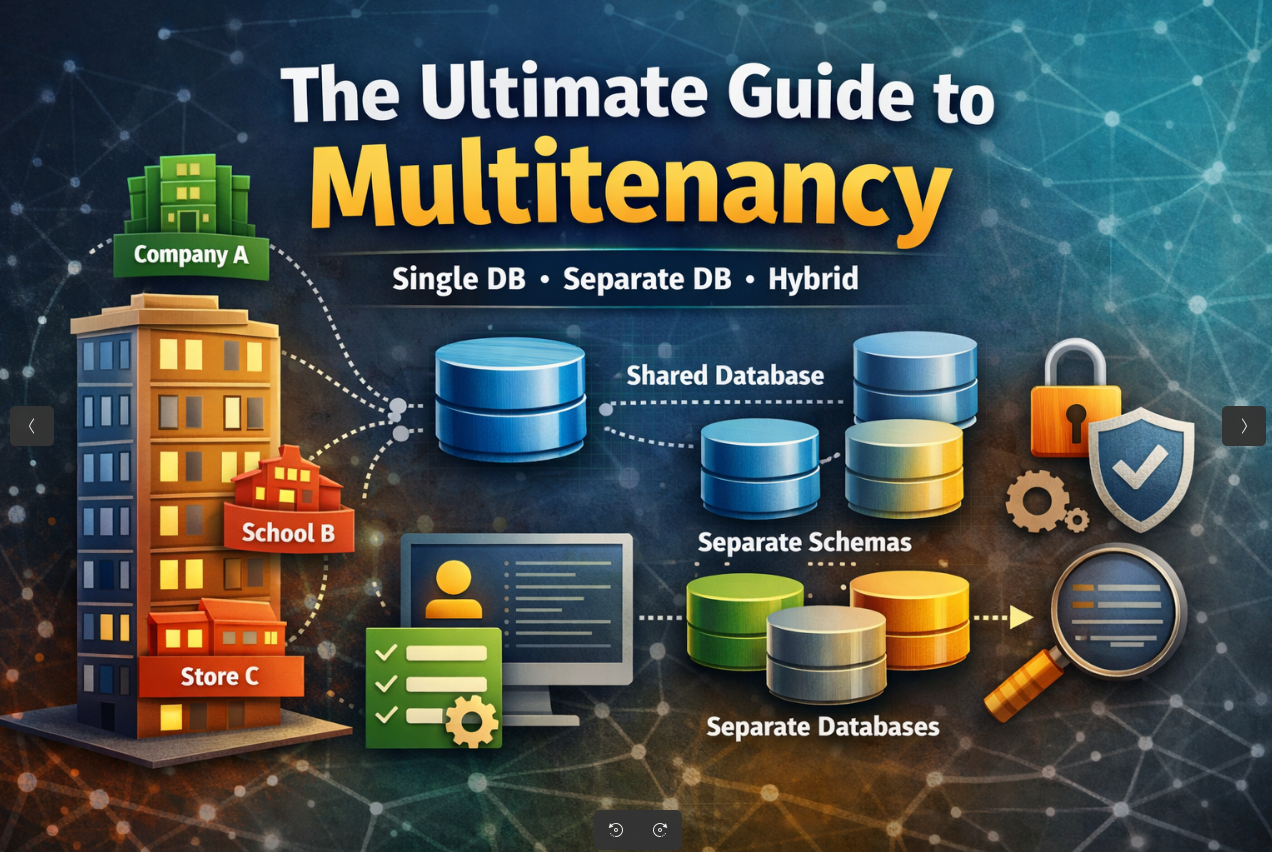
Multitenancy in Web Architecture: Your Ultimate Guide (Single vs Multi Database and Everything In Between)
Modern web platforms — including blog systems, SaaS apps, and content management systems — increasingly need to support multiple customers (tenants) on a shared infrastructure. This architecture is called multitenancy, and it’s essential for scalable, efficient, and cost-effective apps.
In this post we’ll break down:
- What multitenancy really is
- Three core data strategies
- Pros & cons of each
- Real-world scenarios and best practices
What Is Multitenancy?
In simple terms, multitenancy means a single application instance serves multiple groups of users (tenants) — each with their own data and settings — without interfering with each other.
Think of:
- A blog platform where Agency A and Agency B each have their own posts and users
- The same app code but strict isolation between data
- Shared infrastructure but logically separated data
Multitenancy is not just about relationships, but relationships are a big part of how data is separated within the system.
Why You Need Multitenancy
Multitenancy gives you:
- Cost Efficiency — Shared servers and databases reduce hosting costs
- Centralized Updates — One codebase to maintain and deploy
- Scalability — Add new tenants easily without full deployments
But it also raises questions:
How do we store data without leakage? What are the deployment models?
To answer, let’s explore the three common database strategies.
1. Shared Database, Shared Schema
📌 Overview
Everything lives in one database and one set of tables. Each record includes a tenant_id field that tells the app which tenant owns that record.
Example tables:
blogs
  - id
  - tenant_id
  - title
  - body
  ...
comments
  - id
  - blog_id
  - tenant_id
  - text
🎯 Pros
✅ Lowest infrastructure cost
Only one database to manage.
✅ Easiest to scale early
Add tenants quickly without provisioning new databases.
⚠️ Cons
❌ Risk of data leakage if queries aren’t scoped correctly.
❌ Application must always filter by tenant:
SELECT * FROM blogs WHERE tenant_id = ?
This isn’t complex, but every query must include tenant filtering — mistakes lead to security issues.
2. Shared Database, Separate Schema per Tenant
📌 Overview
All tenants share the same database instance, but each tenant gets a separate set of tables (a schema).
Example:
tenant_a.blogs, tenant_a.comments
tenant_b.blogs, tenant_b.comments
🎯 Pros
✅ Better data isolation than shared schema
Each tenant’s data lives in its own tables.
✅ Logical separation still within one database server
⚠️ Cons
❌ More complex to manage migrations — every schema must be updated when you add fields.
❌ Might still need careful permission management within the database.
3. Separate Database per Tenant
📌 Overview
Each tenant has their own database instance. This means:
db_tenant_adb_tenant_b- etc.
🎯 Pros
✅ Strongest data isolation
Good for compliance, audits, and security-sensitive apps.
✅ Custom backups and restores per tenant
✅ Independent scaling per tenant
⚠️ Cons
❌ Highest operational cost
Each DB must be maintained, backed up, and monitored.
❌ More complex DevOps and automation
Beyond the Database: How Multitenancy Works End to End
Multitenancy isn’t just about the database — it also touches:
Tenant Identification
You need a way to figure out which tenant is calling the system. Common strategies:
- Subdomains:
tenant1.yourapp.com - Domains:
tenant1blog.com - Headers or tokens in API requests
Once identified, this tenant context drives logic across your app.
Multi-Tenant Relationships vs Isolation
One common misconception is that multitenancy is just relationships. But that’s only part of the story — relationships model data ownership, not isolation.
✔ Relationships help link users → tenant → blog posts
❌ But without careful architecture, data might still be exposed.
For example, if you forget a tenant_id filter, a user might see another tenant’s blog posts.
Look at this:
Blog.where({ tenant_id: currentTenant.id })
That’s both a relationship and a filter that enforces isolation. Relationships help represent data structure, but correct isolation comes from how you use them.
Hybrid & Advanced Approaches
Sometimes you need some tenants fully isolated and others shared:
⚙ Hybrid Model
- Small tenants → shared DB
- Enterprise clients → separate DB
This gives cost savings, but meets security requirements for bigger customers.
⚙ Row-Level Security
Some databases (e.g., PostgreSQL) offer built-in row-level access policies. These let you enforce tenant data isolation at the database layer instead of the application layer.
Real-World Patterns: When to Use What
ApproachBest ForExampleShared SchemaMany small tenantsPublic blog platformSeparate SchemaModerate isolationPartner CMSSeparate DBSecurity/Compliance requiredHealth / Finance SaaS
Performance & Scaling Considerations
🔹 Shared Schema
- Easy to scale horizontally
- But query size grows as more tenants use the system
🔹 Separate Schema
- Better isolation
- Slightly more complex migrations
🔹 Separate DB
- Best isolation
- More difficult to scale DevOps practices
Security: The Non-Negotiate Part
The key rule: Never trust data without checking its tenant context.
That means enforcing filters globally — in your ORM, middleware, or policies.
Without this, multitenancy is just a name, not a secure architecture.
Conclusion
Multitenancy is a powerful architecture for modern SaaS and content systems like blogs. It allows you to:
✔ Support many customers on one platform
✔ Centralize maintenance and deployment
✔ Scale cost-effectively
But it requires thought in:
📌 Data isolation strategy
📌 Tenant identification
📌 Query scoping and access control
Choose the right model based on your scale, security, and operational goals. Whether you start with shared tables or grow into separate databases, understanding these patterns will guide you to build robust, scalable multi-tenant applications.
Jamhuri Day: Celebrating Kenya’s Journey to Freedo...
Emore Business: The All-in-One Platform Transformi...
Related Articles

Mastering the Maze: The Best Ways to Structure Routes in Lar...
Routing is the backbone of any Laravel application. It's the traffic cop that di...

Building Dreams with Code: My Journey as Founder & Lead Deve...
Hi, I’m Nicholus Munene, a passionate software developer, trainer, and problem s...

Beyond the Code: A Developer's Guide to Choosing the Right W...
Hi, I’m Nicholus Munene, Founder & Lead Developer at Emore Systems. Every day, I...